
British Guiana (British rule, 1796 to 1966)
How Britain took the Dutch colonies, united them as British Guiana in 1831, and ruled until independence in 1966.
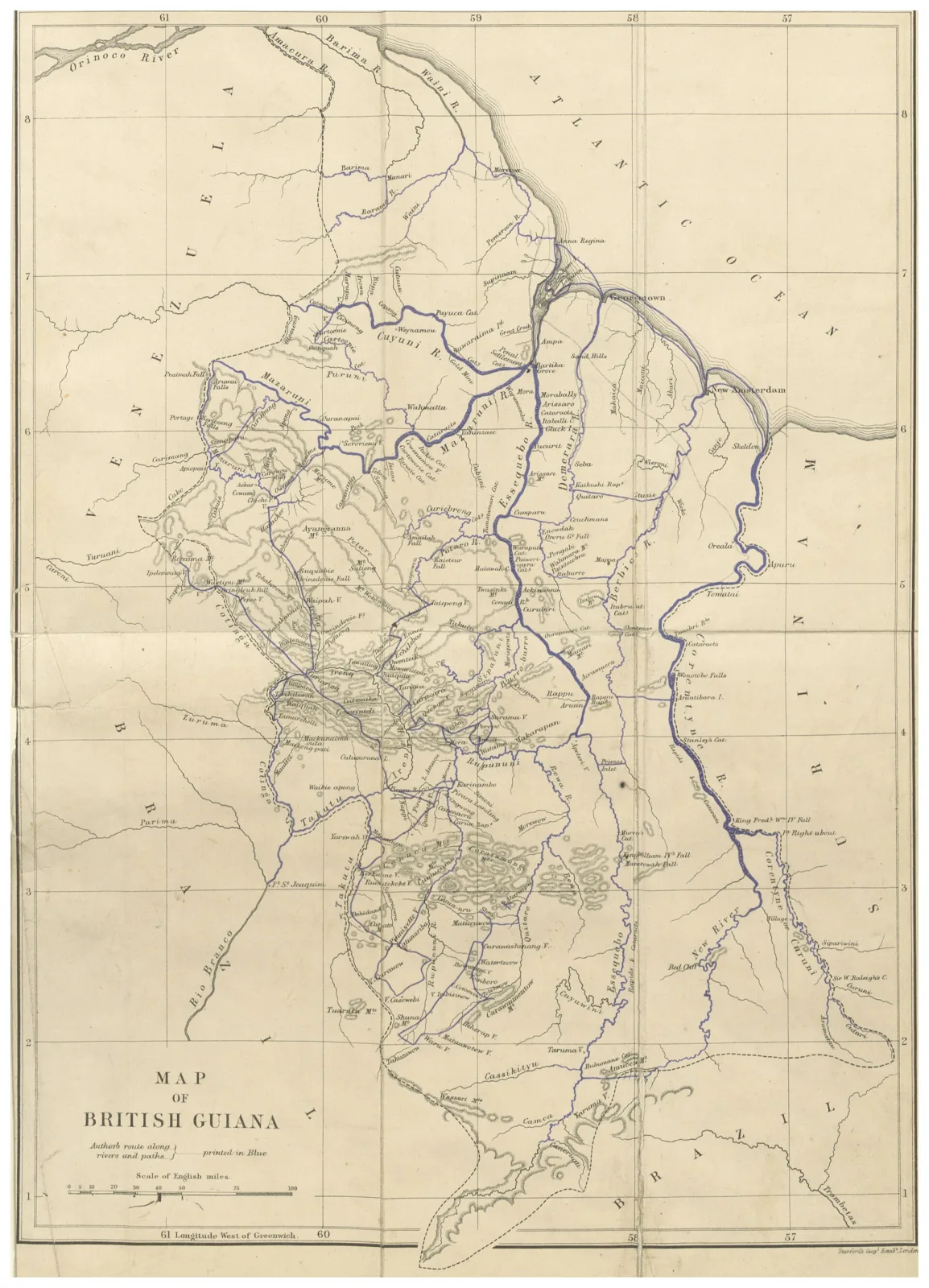
For about 150 years, the land that is now Guyana was the British colony of British Guiana. British rule shaped its laws, language, population and economy.[1]
Taking the Dutch colonies
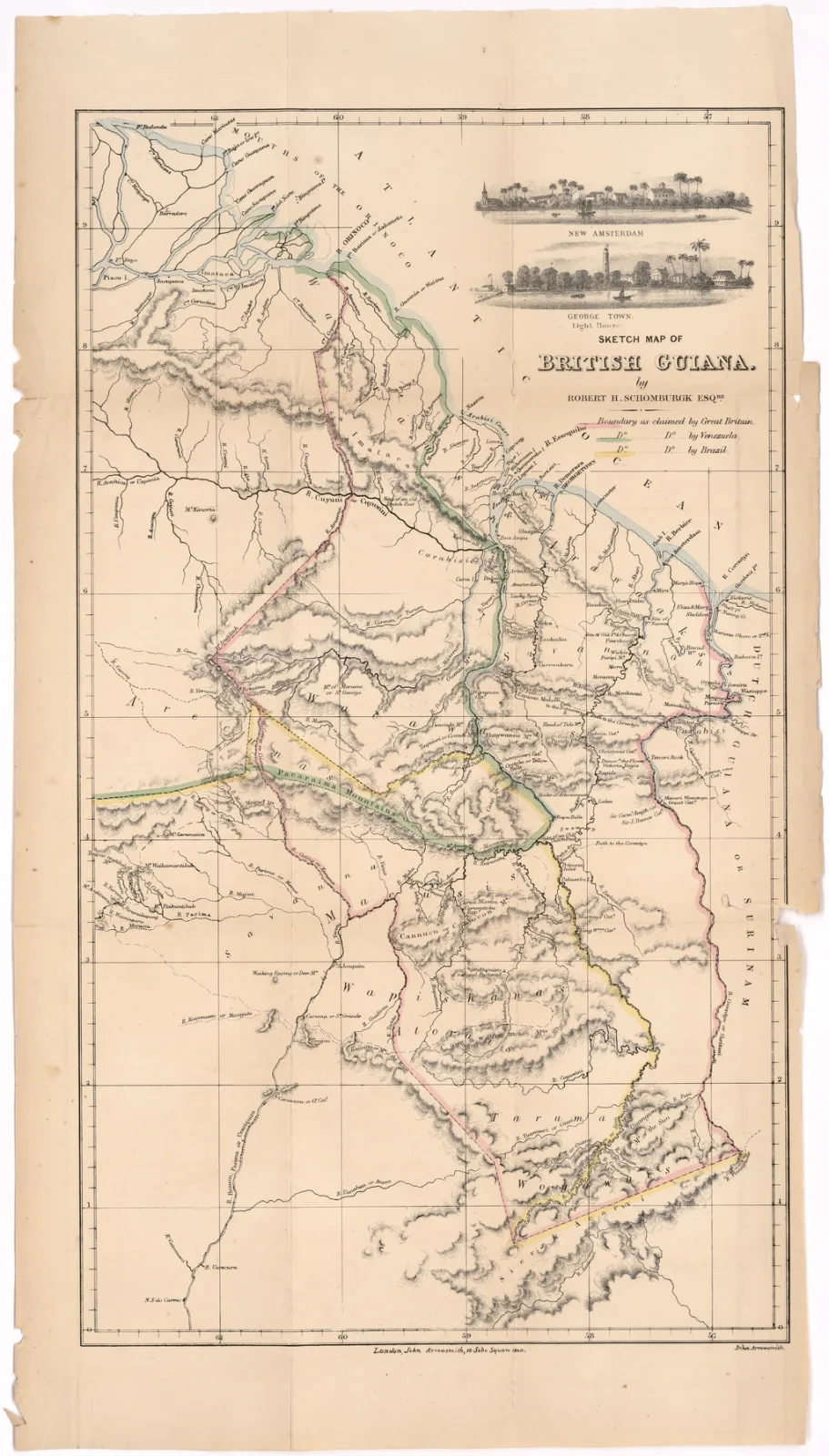
Britain first occupied Berbice, Essequibo and Demerara in 1781 and again in 1796, when an expedition from Barbados took them without bloodshed.[1] The colonies went back to the Dutch under the Treaty of Amiens, were retaken in 1803, and were formally ceded to Britain at the London Convention of 1814.[1] In 1831 Berbice and Demerara-Essequibo were joined as British Guiana.[1][2]
The British kept the Dutch system of government at first. The Court of Policy made laws and the Combined Court controlled taxes and spending. Both were dominated by planters.[1]
A plantation society
In the 1800s, political, economic and social life was controlled by a small European planter class with ties to merchants in Britain.[1] Most people were enslaved Africans until emancipation (see Slavery and emancipation). Afterwards, planters brought in indentured workers from Madeira, China and above all India (see Indentureship).[1][3]
Gold was found in 1879, and a boom in the 1890s helped the colony.[3] Gold in the disputed west also revived the border controversy with Venezuela.[1]
Reform and protest
- 1891: a new constitution weakened the planters a little, abolishing the College of Electors and easing voting rules.[1]
- 1897: the secret ballot was introduced.[1]
- 1905: the Ruimveldt Riots began with a dockworkers' strike in Georgetown. On 1 December, remembered as "Black Friday", police and artillery opened fire at Plantation Ruimveldt.[1]
- 1917: Hubert Nathaniel Critchlow helped found the British Guiana Labour Union, the colony's first trade union. It was given legal status in 1921.[1][4]
- 1928: Britain made British Guiana a crown colony under the tight control of a governor, a step backward in the eyes of reformers.[1][3]
- 1939: the Moyne Commission, set up after unrest across the British Caribbean, urged votes for women and people without land.[1][5]
- 1941 onward: United States forces built the air base that is now Timehri airport under the Lend-Lease arrangement.[1]
- 1943: elected members became a majority on the Legislative Council.[1]
Toward independence
After the Second World War, demands for self-government grew. A 1953 constitution brought universal adult suffrage, and the first elected government was formed that year. Its story, and the road to independence on 26 May 1966, is told in Road to independence.[3]
References
- "History of Guyana". Wikipedia. https://en.wikipedia.org/wiki/History_of_Guyana (accessed 24 Oct 2026) Open source Checked 24 Oct 2026.
- "British Guiana". Wikipedia. https://en.wikipedia.org/wiki/British_Guiana Open source
- Richardson, Bonham C. "Guyana: History". Encyclopaedia Britannica. https://www.britannica.com/place/Guyana/History (accessed 24 Oct 2026) Open source Checked 24 Oct 2026.
- "Hubert Nathaniel Critchlow". Wikipedia. https://en.wikipedia.org/wiki/Hubert_Nathaniel_Critchlow Open source
- "Report of West India Royal Commission (Moyne Report)". Wikipedia. https://en.wikipedia.org/wiki/Report_of_West_India_Royal_Commission_(Moyne_Report) Open source
- "Guyana National Museum". Wikipedia. https://en.wikipedia.org/wiki/Guyana_National_Museum Open source
- "Stabroek Market". Wikipedia. https://en.wikipedia.org/wiki/Stabroek_Market Open source
Categories: History | Colonial era
Text CC BY-SA 4.0. Adapted in part from the Wikipedia articles listed under References (CC BY-SA 4.0). Images are credited under their own licences. Site contact: service@computingcore.net.