
The oil era (2015 to present)
The 2015 Liza discovery in the Stabroek Block, first oil in December 2019, and how oil is changing Guyana.
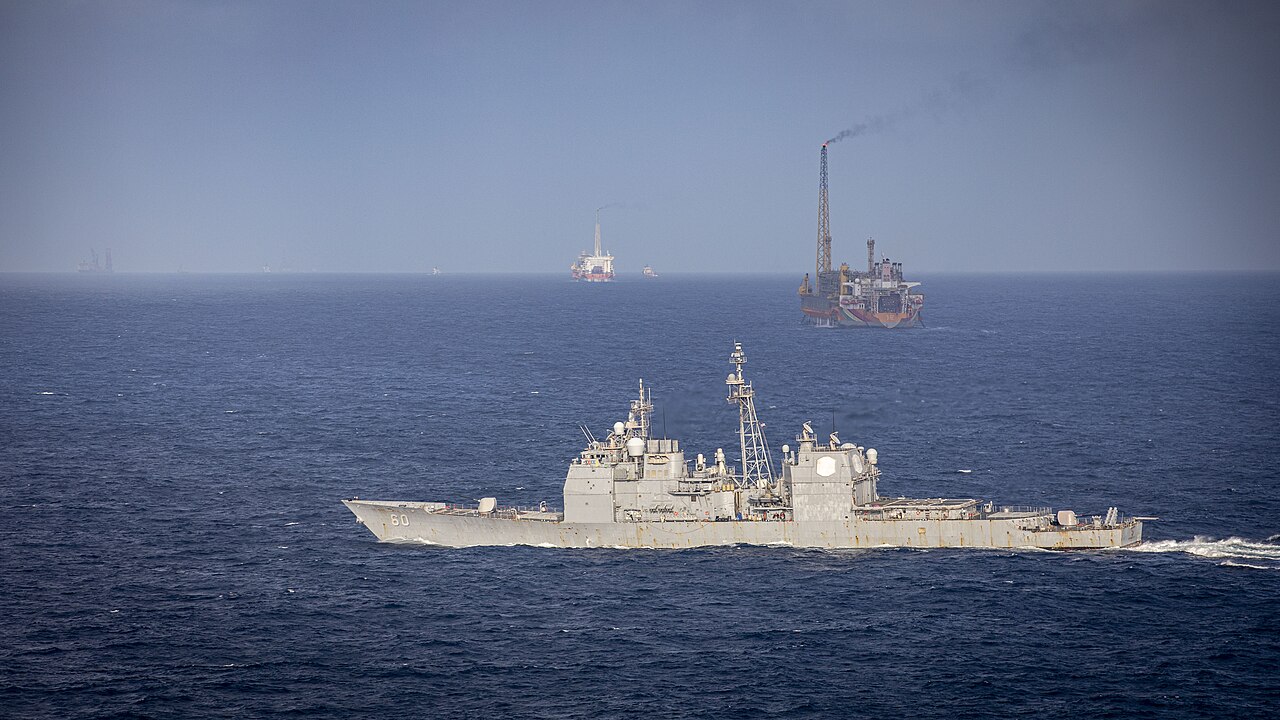
Guyana was historically a net importer of fuel.[1] That changed in 2015 when ExxonMobil found oil off the coast. Guyana is now one of the world's newest oil producers and one of its fastest growing economies.[1][2]
Before 2015
Companies including Shell, Total and Mobil searched for oil offshore and in the inland Takutu Basin from the 1950s, with little success.[1] In the 2000s a rig working for CGX Energy was turned away by Surinamese gunboats. A UN tribunal settled the sea border with Suriname in September 2007.[1][3]
Discovery
Esso, part of ExxonMobil, began exploring offshore in 2008. In May 2015 it announced the Liza-1 discovery about 200 km off the coast, in the Stabroek Block, an area of about 26,800 square km.[1] By May 2024 ExxonMobil estimated its discoveries at about 11 billion barrels of oil equivalent, from more than 30 finds.[1]
The block is operated by ExxonMobil Guyana (45%) with Chevron (30%) and the China National Offshore Oil Corporation, CNOOC (25%).[1]
Production
Liza Phase 1 began producing on 20 December 2019. Further projects started in February 2022 and November 2023.[1] Output reached roughly 645,000 to 660,000 barrels a day in 2024, depending on the source, with plans for about 1.3 million barrels a day by 2027.[1][2] In December 2024 Guyana became the world's third largest oil producer per person.[1]
Oil revenue is paid into Guyana's Natural Resource Fund. In the first quarter of 2025 the fund received about US$605.5 million.[2]
Debate
Oil has brought rapid growth, but also debate.[1]
- Contract terms: critics say the original Stabroek deal favoured the companies. Guyana introduced new model contracts in 2022 with a 10% royalty and corporate tax, but these do not apply to the existing Stabroek contract.[1]
- Resource curse: groups such as Transparency International have warned of the risks seen in other oil-rich countries.[1]
- Climate: Guyana is expanding oil production while its low-lying coast is highly exposed to climate change.[4]
- Border: the finds raised the stakes in the Border controversy.[1][5]
References
- "Petroleum industry in Guyana". Wikipedia. https://en.wikipedia.org/wiki/Petroleum_industry_in_Guyana (accessed 24 Oct 2026) Open source Checked 24 Oct 2026.
- "Economy of Guyana". Wikipedia. https://en.wikipedia.org/wiki/Economy_of_Guyana (accessed 24 Oct 2026) Open source Checked 24 Oct 2026.
- Richardson, Bonham C. and Menke, Jack K. "Guyana: Independence". Encyclopaedia Britannica. https://www.britannica.com/place/Guyana/Independence Open source
- "History of Guyana". Wikipedia. https://en.wikipedia.org/wiki/History_of_Guyana Open source
- "Guyana-Venezuela crisis (2023-2024)". Wikipedia. https://en.wikipedia.org/wiki/Guyana%E2%80%93Venezuela_crisis_(2023%E2%80%932024) Open source
Categories: History | Modern Guyana | Economy
Text CC BY-SA 4.0. Adapted in part from the Wikipedia articles listed under References (CC BY-SA 4.0). Images are credited under their own licences. Site contact: service@computingcore.net.